
When the midsummer sun beats down on the rugged coastline of Busan, the city transforms. The humidity of the East Sea clings to the air, and the bustling streets of Haeundae and Seomyeon become a shimmering haze of heat. In these moments, locals don’t just look for an air-conditioned room; they look for a bowl of ice-cold salvation. We are talking about Milmyeon—the quintessential soul food of Busan that carries the weight of history and the refreshing bite of a seaside breeze.
Unlike the more internationally famous buckwheat-based Naengmyeon, Milmyeon is a testament to resilience, born out of the necessity of using wheat flour during wartime. Today, it has evolved into a culinary masterpiece, a complex harmony of sweet, spicy, and savory notes, served in a bowl filled with slushy, frozen broth. Having experienced diverse food cultures across North America and beyond, I’ve found that few dishes offer the same level of sensory satisfaction as a properly made bowl of Busan cold noodles. It’s not just a meal; it’s a cultural ritual that defines the Busan summer experience.
In this guide, we’re diving deep into two of the most iconic institutions that have perfected this craft: Haeundae Gaya Milmyeon and Dongnae Milmyeon. Whether you are a first-time visitor or a seasoned foodie looking for that authentic local hit, these spots are the gold standard for your summer itinerary.
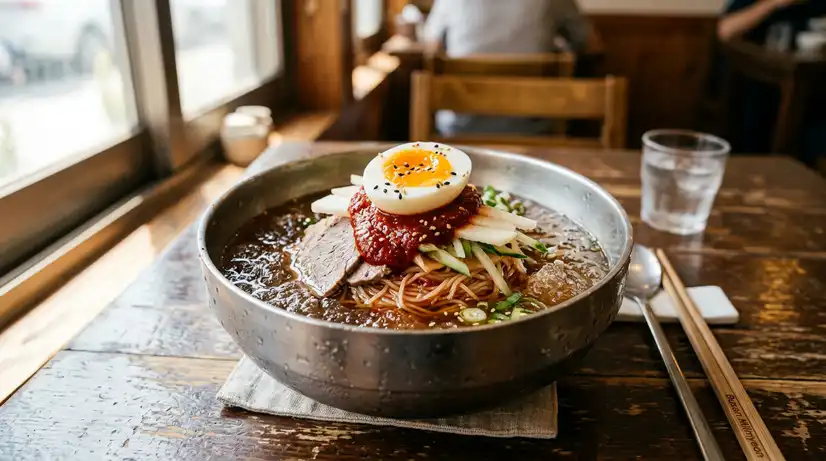
The Master of Patience: Haeundae Gaya Milmyeon
If you find yourself near the iconic Haeundae Beach, your culinary journey is incomplete without a pilgrimage to Haeundae Gaya Milmyeon. With a legacy spanning over two decades, this establishment is often cited as one of the top three Milmyeon spots in the entire city. What sets it apart isn’t just its location, but an unwavering commitment to a broth-making process that borders on the obsessive.
The soul of their Milmyeon lies in a broth that is simmered for a staggering 72 hours. This isn’t just a simple bone broth; it’s a complex infusion of beef brisket, shank, traditional chicken feet, ginger, and onions. But the secret weapon is time. After the boiling process, the broth is aged for over a year. This aging process mellows the harshness of the spices and creates a deep, rounded umami flavor that hits the back of your throat with a subtle, lingering sweetness. It’s the kind of depth you might find in a fine reduction at a high-end bistro in New York or Toronto, yet it remains fundamentally grounded in Korean tradition.
When your bowl arrives, you’ll notice the “Mul-milmyeon” (water noodles) is topped with a signature sauce made from locally sourced onions. It provides a punchy, savory kick that balances the icy temperature of the soup. If you prefer the “Bibim-milmyeon” (spicy mixed noodles), you’re in for a treat; the sauce uses 100% domestic Korean pears, giving it a natural, elegant sweetness that complements the heat of the chili.
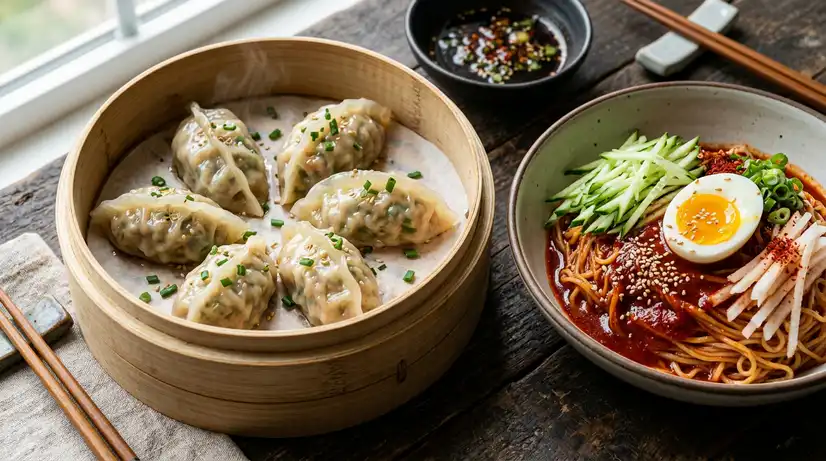
No visit here is complete without an order of their dumplings (Mandu). These aren’t your average flour-skin dumplings. They use a potato starch wrapper (gamja-pi) that results in a translucent, incredibly chewy texture—what locals call “쫀득” (jjon-deuk). It’s the perfect textural contrast to the soft, supple wheat noodles.
A Heritage of Flavor: Dongnae Milmyeon and its Midnight Charm
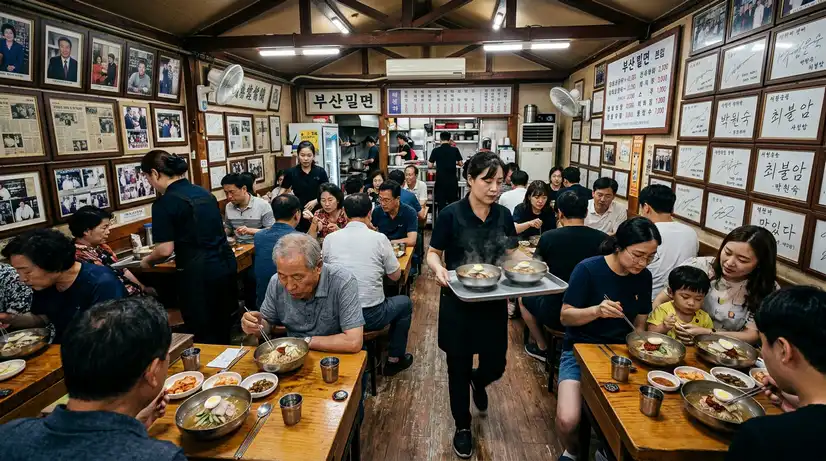
While Haeundae offers a modern, tourist-friendly vibe, Dongnae Milmyeon feels like a step back into the heart of Busan’s local heritage. Located in the historic Suan-dong district, this restaurant has been a staple since the 1970s. It’s the kind of place where the walls are plastered with the signatures of celebrities and athletes, most notably RM from BTS, making it a sacred site for fans and foodies alike.
What distinguishes Dongnae Milmyeon is the aromatic profile of its broth. They incorporate traditional medicinal herbs into the boiling process, resulting in a clean, slightly herbal finish that feels genuinely restorative. In many ways, it reminds me of the sophisticated “farm-to-table” ethos found in the Pacific Northwest—where every ingredient is chosen for its health benefits as much as its flavor. The noodles here are pressed and cooked immediately upon ordering, ensuring a level of elasticity and freshness that pre-packaged noodles simply cannot match.
One of the most unique aspects of Dongnae Milmyeon is its operating hours. Open from mid-morning until 5:00 AM the next day, it serves as both a refreshing lunch spot and the ultimate late-night “hangover cure.” There is something incredibly atmospheric about sitting in a bustling, historical eatery at 2:00 AM, slurping down icy noodles while the rest of the city sleeps.
Their “Wang-mandu” (king-sized dumplings) are also legendary. Unlike the chewy potato-skin versions at Gaya, these are classic, thin-skinned dumplings packed to the brim with a savory pork and vegetable filling. They are “pillowy” and substantial, acting as the heavy-hitting partner to the light, ethereal noodles.
The Art of the Warm Broth: A Pro-Tip for the Full Experience
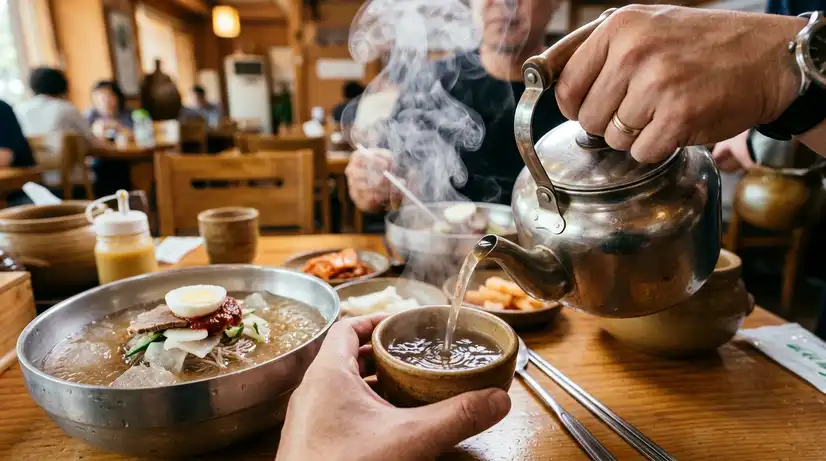
To eat Milmyeon like a true Busan local, you must first understand the “On-yuksu” (warm broth). Most high-quality Milmyeon joints provide a self-service station with a large metal kettle filled with hot, savory broth. It might seem counterintuitive to drink hot soup on a 90-degree day, but it’s an essential part of the experience.
This warm broth is essentially the “concentrate” of the noodle soup. Taking a few sips before your cold noodles arrive does two things: it wakes up your taste buds with deep salt and umami notes, and it prepares your stomach for the icy shock of the main dish. It’s a classic culinary technique—using temperature contrast to heighten the sensory experience. I’ve seen similar concepts in high-end European tasting menus, but here in Busan, it’s a humble, everyday luxury available to everyone.
When the cold noodles finally land on your table, resist the urge to immediately cut them with scissors multiple times. While Milmyeon is easier to chew than Naengmyeon, cutting them into tiny pieces ruins the “slurp-ability” that makes noodle dishes so enjoyable. One or two snips are plenty. Add a splash of vinegar and a dollop of mustard to bring out the brightness of the broth, and you’re ready to dive in.
Beyond the Bowl: Why Milmyeon Matters
To understand Milmyeon is to understand the spirit of Busan itself. It is a city of refugees, sailors, and dreamers—a place that knows how to take something simple, like wheat flour, and turn it into something extraordinary through patience and ingenuity. In a world where food trends come and go like the tide, these Milmyeon houses remain steadfast, offering the same consistent quality year after year.
Whether you prefer the aged, sophisticated depth of Haeundae Gaya or the herbal, historic charm of Dongnae, you are participating in a living history. So, the next time the humidity rises and the sun feels a little too close, head toward the sound of clinking stainless steel bowls and the smell of simmering broth. There is a cold bowl of wheat noodles waiting for you, and it’s arguably the best thing you’ll eat all summer.
FAQ
Q: What is the main difference between Milmyeon and Naengmyeon?
A: The primary difference is the flour used for the noodles. Naengmyeon is made with buckwheat or potato starch, giving it a very chewy, almost rubbery texture. Milmyeon is made from wheat flour, making the noodles softer, easier to chew, and more similar to traditional wheat pasta but served cold.
Q: Is Milmyeon very spicy?
A: It has a spicy kick due to the “Dadaegi” (red pepper seasoning), but it is generally considered “매콤달콤” (mae-kom-dal-kom), which means spicy and sweet. If you are sensitive to heat, you can ask for the sauce on the side or just use less of it.
Q: Why is warm broth served at a cold noodle restaurant?
A: This is called “On-yuksu.” It is a savory beef or chicken-based broth meant to be sipped before or during the meal to aid digestion and provide a deep umami flavor that complements the cold, acidic notes of the noodles.
Q: Do I need to make a reservation for Haeundae Gaya Milmyeon?
A: They do not typically take traditional phone reservations, but they use the “Tabling” app. It is highly recommended to check the app and join the digital queue before you arrive to avoid waiting in the sun.
Q: Is Dongnae Milmyeon really open until 5 AM?
A: Yes, it is one of the few legendary Milmyeon spots that operates nearly 24 hours (closing briefly in the early morning). It is a very popular spot for a late-night meal or for those finishing a night out in the Dongnae area.
Q: Can I park my car at these restaurants?
A: Both have limited parking. Haeundae Gaya allows street parking during the lunch hour (11:30 AM – 2:30 PM), but Dongnae Milmyeon’s lot fills up quickly. It is often easier to use a nearby public parking lot or take the subway.
Q: Which one is better: Mul-milmyeon or Bibim-milmyeon?
A: It depends on your mood! Mul-milmyeon (water) is more refreshing and soup-heavy, perfect for extreme heat. Bibim-milmyeon (mixed) is more intense, spicy, and flavorful. Many locals order one of each and share!
Q: What should I order as a side dish?
A: Dumplings (Mandu) are the essential side dish. The savory meat filling and the specific texture of the skins (especially the potato starch ones at Gaya) are designed to perfectly balance the cold noodles.
Q: Are these restaurants vegetarian-friendly?
A: Generally, no. The broth is made from beef, chicken, and other meat products. The toppings also usually include slices of boiled meat. It is difficult to find a strictly vegetarian version of traditional Busan Milmyeon.
Q: Is it okay to eat Milmyeon alone?
A: Absolutely! These restaurants are very casual and often have many solo diners. The service is fast, and the atmosphere is welcoming to everyone from large families to solo travelers.